Fabian Hildesheim

linkedin · x · github · cv

Click me!

why this site

"Engagement is the key to understanding." David Allen

Writing for a public audience creates greater accountability and forces me to articulate my thoughts more clearly than I do in personal Apple Notes. I am convinced this process sharpens thinking, also I really enjoy reading other people's blogs as it is a quite personal interface into the mind. So, there you go...

now

"You miss 100% of the shots you don't take." Wayne Gretzky

I recently wrapped up my research at Stanford HAI and I'm now on to a new adventure. More to come soon.

personal background

"Think like a man of action, act like a man of thought." Henri Bergson

I grew up in Hamburg. Always loved sports and strategy games. For most of my youth I struggled in school; I was severely dyslexic, unfocused, and rebellious.

I am an electrical and computer engineer, and have worked in machine learning, product, and strategy consulting jobs so far.

I worked at Best Carwash in Osdorf, Hamburg, and in different restaurant chains as a waiter, and liked the simplicity. Over time, first physical and then intellectual challenges got increasingly intriguing to me. At some point it clicked that I wanted to keep putting myself around harder problems.

Since then I did a lot of different things. What I am most proud of are:

thoughts

on China - june 2026

After ten days in China, a few observations.

The wealth gap is doing a lot of work. The delta between rich and poor is enormous, which lets China employ a vast number of cheap service workers and laborers. The result is a very high level of comfort in the cities, excellent conditions for doing business, and highly attractive tourism.

More importantly, it enables unbelievably fast infrastructure buildout. Crews working construction sites 24/7. Being in a 350kmh train, arriving in huge, perfect, super new train stations in multi-million people cities I had never even heard of, and then driving past huge empty apartment block areas felt slightly unreal.

There are estimates of tens of millions of empty apartments, enough to house more people than live in Germany. It nearly triggered a financial crisis, and things still aren't fully stable, but it shows how far the buildout has run.

Decades of European and American outsourcing seem to have produced ever better-developed networks of factories and supply chains. On this foundation, a lot of China's wealth and power is built.

Recipe for success. No worker unions and fast replacement. Strategic development zones: build the basic infrastructure, then sell off to developers, with regulation that enables and enforces deadlines. Basic infrastructure first: workers, energy, market access. Competition between districts and companies. Science documentaries playing on the trains.

The land-finance point seems important too. Local governments fund a huge part of development by turning land into revenue. In 2019, land sales and land-backed financing were apparently 38% of local government revenue. So some of the empty apartment blocks are not just random overbuilding, but part of the fiscal machine itself: build infrastructure, sell land, attract developers, raise GDP, repeat.

Also: China lifted close to 800 million people out of extreme poverty. Not 1.4 billion, but still probably the largest poverty reduction story in history.

What surprised me. Low English skills. A high appreciation for European manufacturing and luxury brands. An aging population. How is that the outcome of deliberate social engineering? The Shenzhen electronics market was crazy: components, repairs, drones, sensors, screens, tiny parts, people who know exactly where to get anything. Hardware there does not feel like an abstract industry. It feels like a physical ecosystem.

BYD's Yangwang brand has an EV that can jump, and a track-focused U9 version that reached basically 500kmh. Xiaomi built an EV as a consumer-electronics company while Apple gave up on the car. Unitree is maybe not "better" than Boston Dynamics in every technical dimension, but it seems much cheaper, faster, and much more plugged into the Chinese hardware ecosystem. Shenzhen has an entrepreneurial buzz comparable to SF, but with better access to robotics components and electronics manufacturing than anywhere else.

Challenges. Youth unemployment. Surveillance that limits perceived freedom and pushes rebellion underground. I don't think that's a sustainable state of existence, though this may be my libertarian bias. Power conflicts between the party and companies (Jack Ma, real-estate executives). Access to global capital markets, where Taiwan is the perfect point of leverage.

And demographics: China is getting old very quickly. The 2025 population sample has 22.86% of people above 60. That seems like a huge problem for the cheap-labor advantage, consumption, pensions, and the whole development model.

So what? The thing I keep returning to is that China's edge is less about any single technology than about a system tuned for execution speed: cheap labor, infrastructure, manufacturing depth, local government incentives, and competition all pointed at shipping physical things fast.

The open question is how durable that is once the cheap-labor delta narrows, the population ages, the property machine slows down, and the political-economic frictions compound.

on Limitless Mind

to be added

on AI adoption - march 2026

Since starting my research at Stanford Institute for Human-Centered Artificial Intelligence (HAI), I realized 3 points are not publicly discussed with sufficient clarity:

1. The delta of AI Adoption (whats technically possible vs. whats practically implemented) is more significant than you might think. And this delta is relevant for almost all jobs!

2. There are massive individual differences in productivity uplift. OpenAI calls this "Capability Overhang". They measured across 70+ countries and found that power users leverage 7x more thinking capabilities than average ones. This underscores that using AI is clearly, to some extent, a learnable skill, probably a bit like a mixture of managing a team, formulating a research question and critically reviewing an essay.

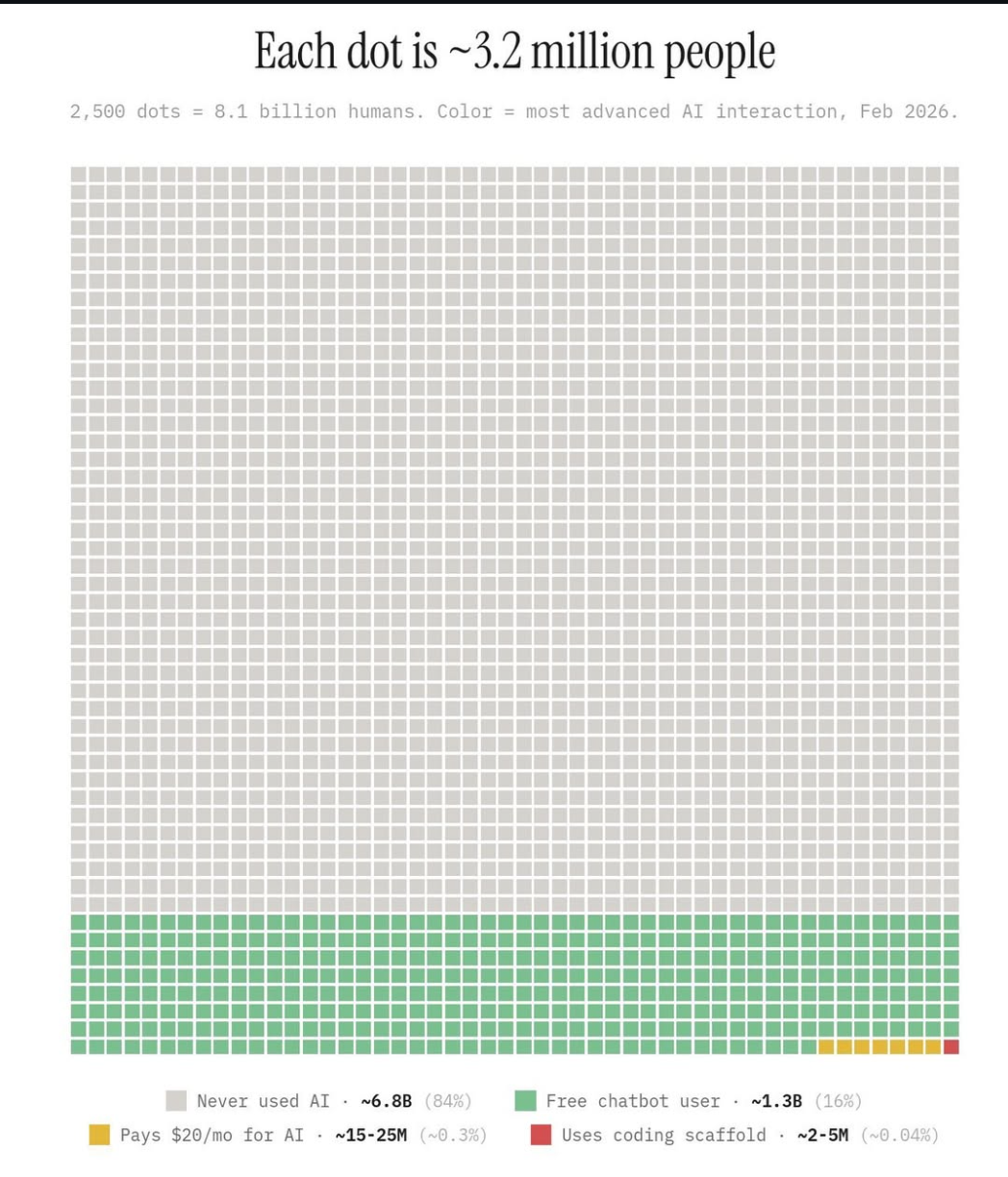
3. It's a huge problem that compute, data, AI talent, and funding are already so centralized in the hands of a few people, companies, and countries. Most people on earth have never even used an LLM! Given the 2 points above, it is very important that more people experiment with LLMs, take bolder measures to catch up in adoption, and ensure that productivity gains translate into actual improvements of our society!
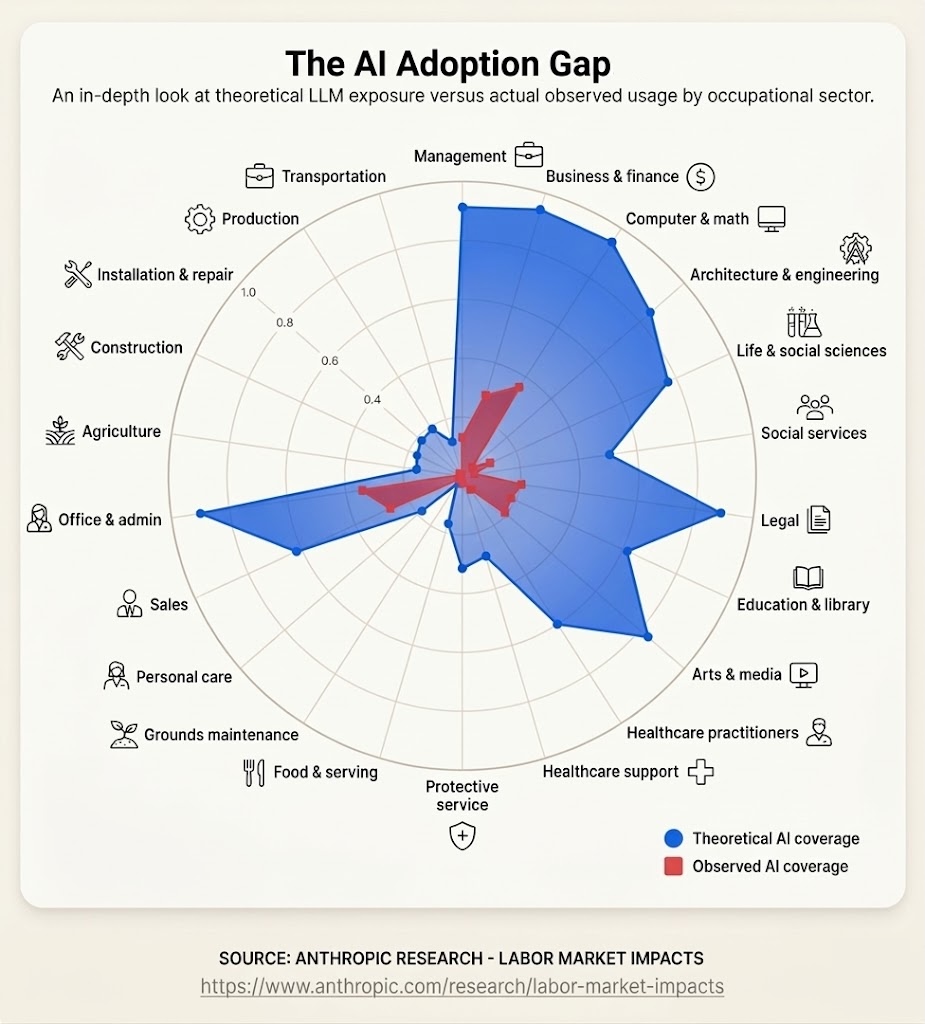
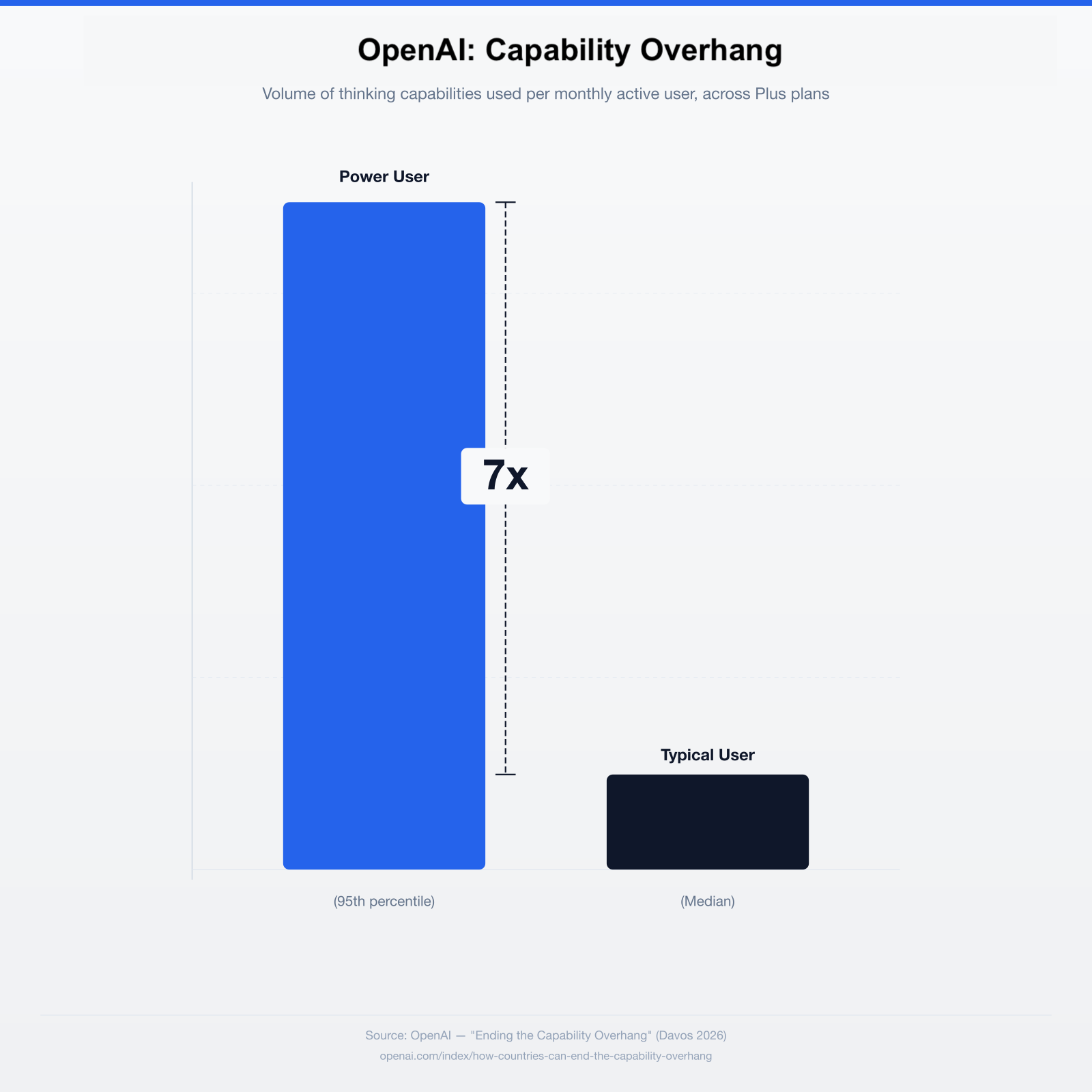
Anthropic graph OpenAI Capability Overhang Humanity graph
on altruism

to be added

on Africa

to be added

foundational beliefs - august 2024

"Change is not only always possible, but a requirement of history."

1. Everything is in constant transition, which is a contrast to our state-specific way of perceiving the world.

2. While it is more likely that there is no meaning in anything, we have no other option than acting as if there was one.

3. The best approximation to meaning for me seems to develop an actionable world model upon which one can make accurate predictions about fundamental relationships, improve my own openness and ability to act upon my beliefs, and with that to pursue happiness for the largest amount of people possible.